Personal Yoga Trainer at Home in Safdarjung Enclave (110029) | Certified Yoga Classes Near AIIMS
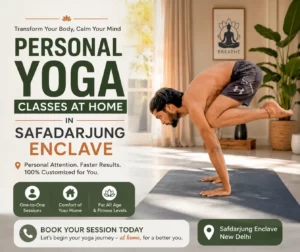
Safdarjung Enclave sits in one of Delhi’s more unusual daily rhythms — a residential neighborhood living right alongside AIIMS and Safdarjung Hospital, home to doctors working rotating shifts, families managing a loved one’s recovery, and hospital staff whose schedules rarely match a typical 9-to-5. A fixed studio timetable doesn’t work for a lot of people here. A personal yoga trainer at home in Safdarjung Enclave does.
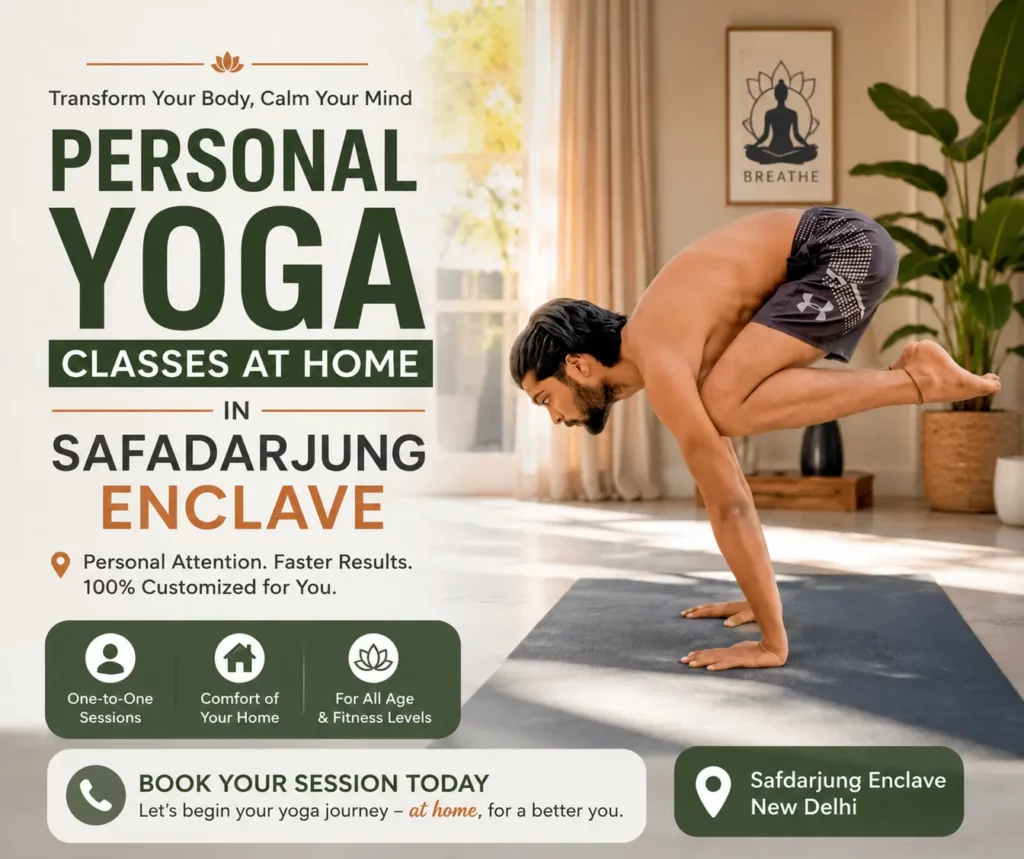
Eazyyoga sends certified trainers directly to homes and independent floors across Safdarjung Enclave, building sessions around whatever hours actually fit — night-shift mornings, evening wind-downs, or whenever there’s a genuine gap in the day. There’s no fixed batch to catch up with, no studio timetable to work around, and no commute added to a day that’s often already full of one.
In a neighborhood this close to two major hospitals, trust matters more than it might elsewhere. Trainers working here regularly encounter clients managing real medical situations — post-surgical recovery, chronic conditions, caregiver exhaustion — and the approach reflects that: cautious, well-informed, and always deferential to whatever a doctor has already advised, rather than positioning yoga as a replacement for medical care.
Living Near a Major Hospital Changes What “Fitness Routine” Even Means
For a lot of Safdarjung Enclave residents, the question isn’t “when’s a good time for the gym” — it’s “when am I not at the hospital, on call, or looking after someone who is.” A neighborhood built around a major medical institution runs on a different clock than most of Delhi: shift changes instead of office hours, waiting-room hours instead of lunch breaks, and days that can be reshuffled entirely by a single phone call. Personal yoga classes at home remove the one variable that a studio can’t accommodate: a fixed schedule. Sessions here are booked around actual availability, not the other way around, and if that availability shifts from one week to the next, the schedule shifts with it.
A Day in the Life: How a Session Adapts to Hospital Hours
What a session looks like here depends entirely on who’s booking it. For a resident doctor coming off a night shift, a session might mean a short, restorative practice at 9 a.m., focused more on winding the nervous system down than building intensity. For a family member who’s spent the week in a hospital waiting room, it might mean a gentle 6 p.m. session that’s less about exercise and more about getting fifteen uninterrupted minutes to breathe. For someone recovering from a procedure, it might mean a slow, seated sequence built entirely around what their doctor has cleared them to do that week. For a student preparing for exams while living nearby, it might simply mean twenty minutes of stress-relief breathing squeezed between study blocks. None of these look like a typical studio class, and that’s exactly the point — the format bends to the person, not the other way around.
Why a Home Trainer Fits This Neighborhood Specifically
- No fixed timetable — sessions scheduled around shift work, hospital visits, or unpredictable days, and rescheduled without friction when plans change at the last minute.
- No travel required — one less thing to plan around an already demanding schedule, especially valuable after a long shift or a stressful hospital visit.
- Complete privacy — a calm, quiet session away from hospital corridors, waiting rooms, and the general noise of caregiving.
- One-to-one pacing — no group class to catch up with after a missed week, and no pressure to keep up with anyone else’s pace.
- Trainer awareness of medical context — sessions built around whatever recovery or care situation is already in place at home, adjusted as things change.
Gentle Support for Recovery
Recovering from surgery, a hospital stay, or a serious illness usually comes with a long list of things a person can’t do yet, and very little guidance on what they can. Gentle, therapeutic yoga sequences — built specifically around a doctor’s clearance — can support mobility, comfort, and a sense of gradual progress during that stretch. This might mean seated breathing exercises in the first week, gentle stretching as strength returns, and gradually more movement as recovery continues. None of this replaces medical care or physiotherapy already in place; it works alongside it, at a pace set entirely by what’s medically appropriate at each stage.
Support for Caregivers, Too
The second group that comes up often in Safdarjung Enclave is the family members supporting someone through treatment or recovery. Caregiving is exhausting in ways that are easy to underestimate — irregular sleep, constant vigilance, and very little time carved out for anything that isn’t directly about the person being cared for. A short, calming practice built around breathwork and gentle movement can be one of the few parts of the day that’s actually restorative rather than another item on a long list of responsibilities. Sessions for caregivers are often shorter and more flexible by design, since the goal isn’t an intense workout — it’s a reliable pocket of calm in an unpredictable week.
Health Benefits Worth Knowing About
Beyond the scheduling flexibility, a consistent practice offers real, tangible support for the specific pressures this neighborhood tends to bring — whether that’s disrupted sleep from shift work, the physical toll of standing through long hospital shifts, or the accumulated stress of caregiving:
- Better sleep — particularly valuable for anyone dealing with disrupted sleep from shift work or overnight caregiving.
- Stress and anxiety management — through guided breathwork and mindful movement, useful for both patients and the people supporting them.
- Improved mobility and flexibility — especially relevant during a gradual recovery process.
- Back and neck relief — common among hospital staff who spend long shifts standing or bent over a patient bed.
- Support for blood pressure and blood sugar — alongside whatever a doctor has already recommended, never as a replacement for it.
- A sense of routine — something that’s often the first thing to disappear when life revolves around hospital schedules.
Types of Yoga We Offer
- Hatha Yoga — a gentle, foundational starting point for anyone new to the practice.
- Restorative Yoga — supported, low-effort postures designed for rest and recovery.
- Therapeutic Yoga — targeted sequences for post-surgical recovery and chronic pain, developed around a doctor’s guidance.
- Chair Yoga — seated practice for limited mobility or early-stage recovery.
- Pranayama and Meditation — breathing and mindfulness practices for stress relief and better sleep.
- Vinyasa and Power Yoga — more energizing formats for anyone with the capacity and clearance for a stronger session.
Why Choose Eazyyoga
- Certified trainers with genuine teaching experience, including therapeutic and recovery-focused training.
- Male and female trainers available, based on your comfort.
- Scheduling that adapts around shift work and hospital-driven routines, including last-minute changes.
- Sessions that work alongside existing medical guidance, not instead of it.
- A calm, patient teaching style suited to people managing a stressful or uncertain period.
- Transparent, affordable pricing with no long-term lock-in.
Why Trainer Experience Matters Even More Here
Not every yoga trainer is equipped to work with someone recovering from a procedure, managing a chronic condition, or simply running on very little sleep after a night shift. It takes a different kind of judgment to know when to hold back, when a client is pushing too hard, and when a session should be entirely about breath and stillness rather than movement at all. Eazyyoga trainers assigned to this area are chosen specifically for that kind of experience — the ability to read a room, adjust on the spot, and prioritize safety over a fixed lesson plan.
What to Expect From Your First Trial Session
- A short phone consultation to understand your schedule, any medical context, and what you’re hoping to get out of sessions.
- A trainer match based on your preference and specific situation — recovery-focused, caregiver-focused, or a general fitness routine.
- A gentle first session at home, with no pressure to perform at a particular level.
- An honest conversation afterward about pace, frequency, and what adjustments might help going forward.
- Ongoing flexibility as your schedule or situation changes over time.
Who This Is For
The typical Eazyyoga client base in Safdarjung Enclave includes a wider mix of situations than most neighborhoods, largely because of what’s next door:
- Doctors and hospital staff working rotating or overnight shifts, looking for something that fits around an unpredictable roster.
- Family caregivers supporting a relative through treatment or recovery, often with very little time carved out for themselves.
- Patients cleared for gentle movement post-surgery or post-hospitalization, working within whatever limits their doctor has set.
- Students living nearby for AIIMS-related studies, managing academic stress alongside demanding schedules.
- Senior citizens managing chronic conditions who want gentle, joint-safe movement at home.
- General residents who simply want a consistent practice that doesn’t depend on a fixed weekly slot.
Also Serving Nearby Neighborhoods
Alongside Safdarjung Enclave, Eazyyoga trainers regularly cover Green Park, SDA, Hauz Khas, Panchsheel Park, and the area around IIT Delhi and Deer Park.
Quick Questions
Can sessions be scheduled around night shifts or irregular hours?
Yes — this is one of the most common scheduling needs in this neighborhood, and trainers work around it directly, including last-minute rescheduling when a shift changes unexpectedly.
Is this suitable for someone recovering from surgery?
Yes, with a doctor’s clearance. Gentle, restorative sequences are built around whatever stage of recovery someone is at, and adjusted as that changes.
Can a family caregiver join a session too?
Yes — many sessions include a caregiver alongside the person recovering, at whatever pace works for both of them.
Do I need any equipment at home?
Just a yoga mat and enough floor space to move comfortably — roughly 6×4 feet is enough for most sessions.
What if I need to cancel or reschedule at short notice?
Given how common last-minute changes are in this neighborhood, trainers are used to flexible rescheduling rather than a strict fixed-slot policy.
Can sessions be very short if that’s all the time available?
Yes. Sessions can be shortened when needed — a brief, focused practice is still worthwhile, especially for caregivers with limited windows of free time.
How do I get started?
A short call to understand your schedule and any medical context, followed by a trial session at home.
Will the trainer coordinate with my doctor or physiotherapist?
Trainers work based on the guidance you share from your doctor or physiotherapist, adjusting sessions accordingly — direct coordination between providers isn’t standard, but any restrictions or instructions you pass along are followed closely.
Is this only for people with a medical situation, or can anyone book?
Anyone in the neighborhood can book a session — the flexible, medically-aware approach is simply part of how trainers here are trained to work, whether or not a client has a specific condition.
Book a Personal Yoga Trainer at Home in Safdarjung Enclave
Whether your days revolve around hospital shifts, a loved one’s recovery, or simply an unpredictable schedule, a personal yoga trainer at home in Safdarjung Enclave works around it. Eazyyoga brings certified, one-to-one instruction directly to your door, with the flexibility this neighborhood actually needs.
Ready to start? Book your trial session with Eazyyoga and experience certified, personal yoga classes at home in Safdarjung Enclave.
📞 Call or WhatsApp: +91 8826076401